How Do Lithium-ion Batteries Work?
Understanding the Technology Powering the Electric Revolution Astrolabe Analytics Blog | Updated 2026
Lithium-ion batteries have transformed modern life. They power our smartphones, laptops, electric vehicles, and increasingly, the grid-scale storage that makes renewable energy reliable. As demand surges for cleaner energy and electrification, understanding how these batteries work is more important than ever.
At Astrolabe Analytics, we specialize in battery performance analysis, health monitoring, and predictive analytics. Our work helps companies and organizations maximize battery life, safety, and value. This guide explains the fundamentals clearly while highlighting why these batteries dominate and what the future holds.
A Brief History
The foundations of lithium-ion technology earned John B. Goodenough, M. Stanley Whittingham, and Akira Yoshino the 2019 Nobel Prize in Chemistry. Sony commercialized the first Li-ion batteries in 1991 for camcorders. Since then, they have enabled the portable electronics boom and now drive the shift to electric vehicles and renewable energy storage.
Battery Anatomy: The Key Components
A lithium-ion battery cell consists of four main parts:
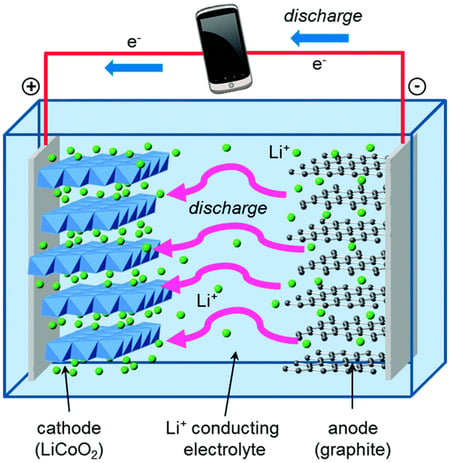
- Anode (Negative Electrode): Usually made of graphite (carbon). During charging, lithium ions insert themselves between graphite layers via a process called intercalation.
- Cathode (Positive Electrode): Typically a lithium metal oxide, such as lithium cobalt oxide (LCO), lithium iron phosphate (LFP), or nickel-manganese-cobalt (NMC). This is where lithium ions originate during discharge.
- Electrolyte: A liquid or gel containing lithium salts in an organic solvent. It allows lithium ions to flow between anode and cathode but blocks electrons.
- Separator: A porous membrane that prevents the electrodes from touching (which would cause a short circuit) while letting ions pass through.
Current collectors (copper for the anode, aluminum for the cathode) connect the electrodes to the external circuit.
How Lithium-Ion Batteries Actually Work
The magic lies in the reversible movement of lithium ions (not the electrons directly powering your device).
During Discharge (Providing Power):
- Lithium ions leave the anode (graphite) and travel through the electrolyte to the cathode.
- Electrons, released at the anode, flow through the external circuit (your phone, motor, etc.), creating electrical current.
- At the cathode, lithium ions re-insert and combine with the electrons.
During Charging: The process reverses. The charger forces electrons back toward the anode, pulling lithium ions back from the cathode to the anode.
This "rocking chair" movement of ions is highly reversible, allowing hundreds or thousands of charge cycles—unlike alkaline batteries, which are typically single-use due to irreversible chemical changes.
A typical nominal voltage per cell is around 3.6–3.7V, significantly higher than the 1.5V of AA alkaline batteries, contributing to compact, high-energy designs.
Why Lithium-Ion Batteries Excel
- High Energy Density: They store more energy per unit weight/volume than most alternatives.
- Rechargeability: Excellent cycle life, especially with modern chemistries like LFP.
- Low Self-Discharge: They hold charge well when not in use.
- Efficiency: Round-trip efficiency often exceeds 90%.
Common Chemistries:
- NMC/NCA: High energy density → favored for long-range EVs.
- LFP: Superior safety, longevity, and lower cost (no cobalt/nickel) → popular for stationary storage and affordable EVs.
Limitations and Safety Considerations
Lithium-ion batteries are not perfect. They can overheat or catch fire if damaged, overcharged, or manufactured with defects (thermal runaway). Modern battery management systems (BMS) mitigate this with voltage, temperature, and current monitoring.
Other challenges include:
- Cost and supply chain issues for materials like lithium, cobalt, and nickel.
- Degradation over time (capacity fade).
- Environmental impact of mining and end-of-life disposal (though recycling rates are improving).
Real-World Applications
- Consumer Electronics: Smartphones and laptops.
- Electric Vehicles: The heart of Tesla, BYD, and other EVs.
- Grid Storage: Stabilizing solar and wind power.
- Aviation and Heavy Industry: Emerging uses in electric aircraft and equipment.
The Future: Innovations on the Horizon
Research focuses on:
- Silicon anodes (higher capacity than graphite).
- Solid-state electrolytes (improved safety and energy density).
- Faster charging and longer lifetimes.
- Sustainable, cobalt-free materials.
At Astrolabe Analytics, we use advanced data analytics to predict battery health, optimize performance, and extend lifespan in real deployments—critical as batteries scale in EVs, fleets, and energy storage.
Conclusion
Lithium-ion batteries work through a sophisticated yet elegant dance of ions and electrons enabled by carefully engineered materials. Their dominance stems from high performance, rechargeability, and continuous improvement.
As the world electrifies, reliable battery insights become a competitive advantage. Whether you're managing an EV fleet, deploying energy storage, or developing next-gen battery tech, Astrolabe Analytics delivers the data-driven intelligence you need.
Ready to optimize your batteries? Schedule a consultation with our team today.
Robert Masse and the Astrolabe Analytics Team Experts in Battery Analytics and Predictive Maintenance